Early Season Arthurs Lake and the wet fly
Arthurs Lake, it is different, but it still is good
Every time I visit Arthurs Lake, I am always nostalgic for the 90s and 2000s, but still optimistic for the future. For those who knew this lake when the water was clear and the hatches were big, the current visual state of the lake is disappointing. But that doesn’t mean that it isn’t good—just different.
One thing that is still consistent though, is the quality of the wet fly fishing in the early months of the season. The following are a few spots and some tricks to hopefully get a few more anglers back onto Arthurs and into the early season trout.
The photo at the bottom of this yarn was taken from Google Earth. The date that Google said the satellite took the image was the 13th of December in 2025. On that date, or thereabouts, the level of Arthurs was 2.4m below full supply. That’s a pretty good level. The current level as at the end of June 2026 is about a metre lower. Anywhere between those two levels is very good for the beginning of the season in August.
In my experience of Arthurs, it fishes well at all levels between -1.5m and -4m. Just differently. If I were to pick a favourite lake level for classic Tasmanian wet fly pulling from a drifting boat, then I think around -3.0m is perfect.
The key to Arthurs and the wet fly early in the season is structure first, weeds second. With a lower level, those solid weed beds that are around 3-4m below the surface at ‘normal’ levels are now 2-3m below the waves. Those rocky ‘reefs’ are now either just below the surface, just poking out, or as I like them, about 1.5m down. I mostly work in the old imperial measurements with trout—my favourite depth is four feet, which is about 1.5m.
I’ve marked on the below Google Earth image a few of my favourite drifts when the wind is from the north west and the sky has more cloud than blue. These are the main ones that I’ve always done well on, starting right back when I first bought my old Purdon dinghy with a 6hp Evinrude. What the numbers mean is at the end of this yarn.
In those days of slow boats—the Purdon was a displacement hull—you quickly learnt to maximise the opportunity at each spot. It might take you 10 minutes to get to the next spot!
The key to these drifts is getting the best angle of the wind to the structure. A good breeze of around 10 knots is perfect. An easy way to work out wind strength is that when the white caps start to form, that’s about ten knots. A wind like this will set up a good current flowing past the rocky structures and the trout love this. They will hang around the structure and look for other things hanging around the structure: like galaxia, scud, stick caddis and size 8 Woolly Buggers, Yetis, Matukas and size 12 Alexandras. If it’s a very rough day, size 6 and 4 are good too. You shouldn’t worry about big flies, remember the best soft plastic lure on Arthurs is 75mm long!
In four feet deep water and ten knots of wind, all you need is a medium-fast sink tip line or a clear intermediate, ten feet of 4x leader and two or three flies. Cast them out 40 feet, let them sink while keeping in touch with the flies (figure eight retrieve is perfect) and then pull ‘em back in. Don’t forget to hang the flies at the boat before recasting, as this is when those dopey early season browns finally make the wrong decision…
Fly choice is all about confidence. I usually tie a black bead head Fuzzle Bugger on the point, a green Fuzzle Bugger in the middle and something resembling a Claret or Pearly Dabbler on the top. Four feet apart if you are using a ten foot rod.
The late and legendary Bill Beck caught prodigious amounts of trout in Arthurs pulling Cat Flies on sink tip lines early in the season, so don’t think it is all about Woolly Bugger variations.
If the wind does get quite gusty, drop back to two flies three feet apart and fish a faster sinking fly line. The stronger the wind, the better the fishing will be—up to a point. In strong wind, cast at 45 degrees to the boat and let it swing around as you fish it back, it stays in the water longer and the fish won’t see the boat.
In August, the weather is rarely warm, more less cold! I don’t worry about fishing earlier than ten in the morning and the boat is usually back on the trailer by four bells. The Jonah Bay ramp is as good as any early in the season as some of the best fishing will be within sight of the ramp. Space to park your trailer shouldn’t be an issue…
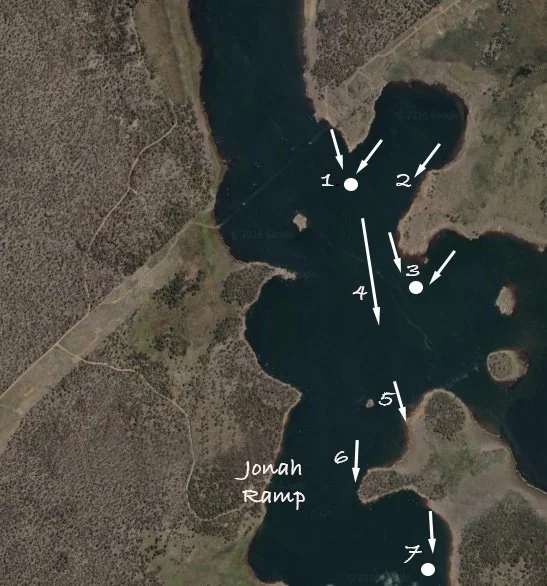
Suggested early season wet fly drifts on Arthurs Lake
What the numbers mean…
1. There is a rocky reef in amongst a cluster of dead trees off this point; usually there are plenty of fish on it. There are quite a few limbs under the surface, so expect to lose the odd fly.
2. This shore on the eastern side of Seven Pound Bay is ultra-reliable in the early season.
3. Just off this point is a reef. I found it with the leg of my outboard on the old Purdon. Probably my first go-to spot to get a feel of what the day might be like.
4. Deeper water over very fertile bottom. Fast sinking line territory. Some of the best-tasting fish in Arthurs come from here.
5. Good shore if the wind is blowing onto it. If there is a decent wave, the fish will be hard on the shore. The Soldier Palmer is an excellent top dropper here.
6. This is classic wet fly water as the shoreline drops off nicely and with around 2km of fetch, a very good current builds up. Great mid-afternoon spot if it’s been a calm start to the day.
7. There is a reef/ outcrop roughly where the white dot is. It goes from about four feet (depending on level of course) to about eight feet. If there is a good foam line forming, keep following it till you hit the shore about 100m across the bay—maybe switch to a fast sinking line once you are past the drop off.
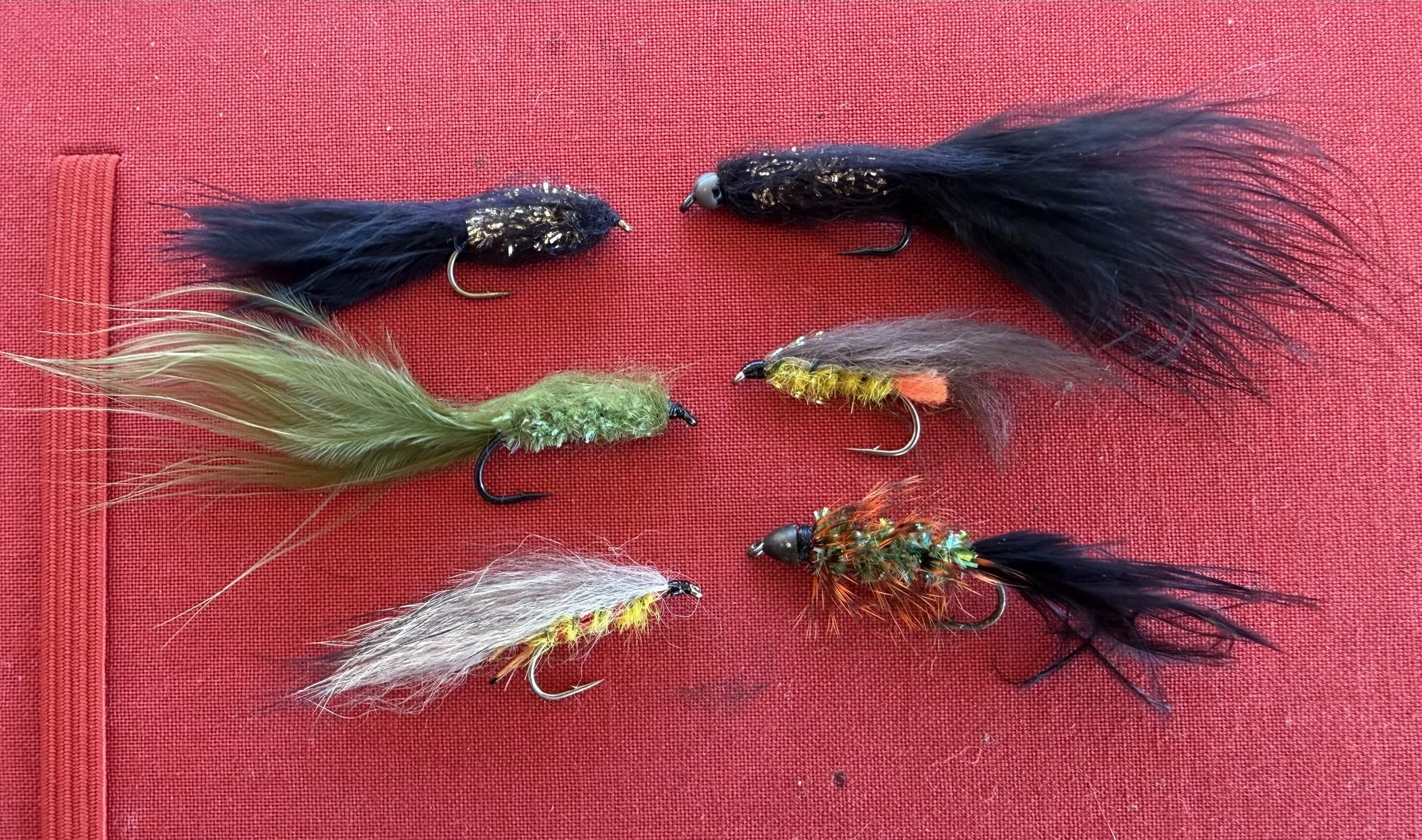
Proven wet flies for the early season
Flies
Top row: Muz Wilson Gold and Black Fuzzle Buggers
Middle Row: Muz Wilson Olive Fuzzle Bugger and Bill Beck Cat Fly
Bottom Row: Bill Beck Cat Fly and Bruce Gibson’s Conan the Barbarian